QuickBooks alternatives that let you keep your own data
A QuickBooks alternative that lets you keep your own data is one where your books exist as a file you hold and can read yourself — not as rows in a database you rent access to and can only leave through an export button the vendor maintains.
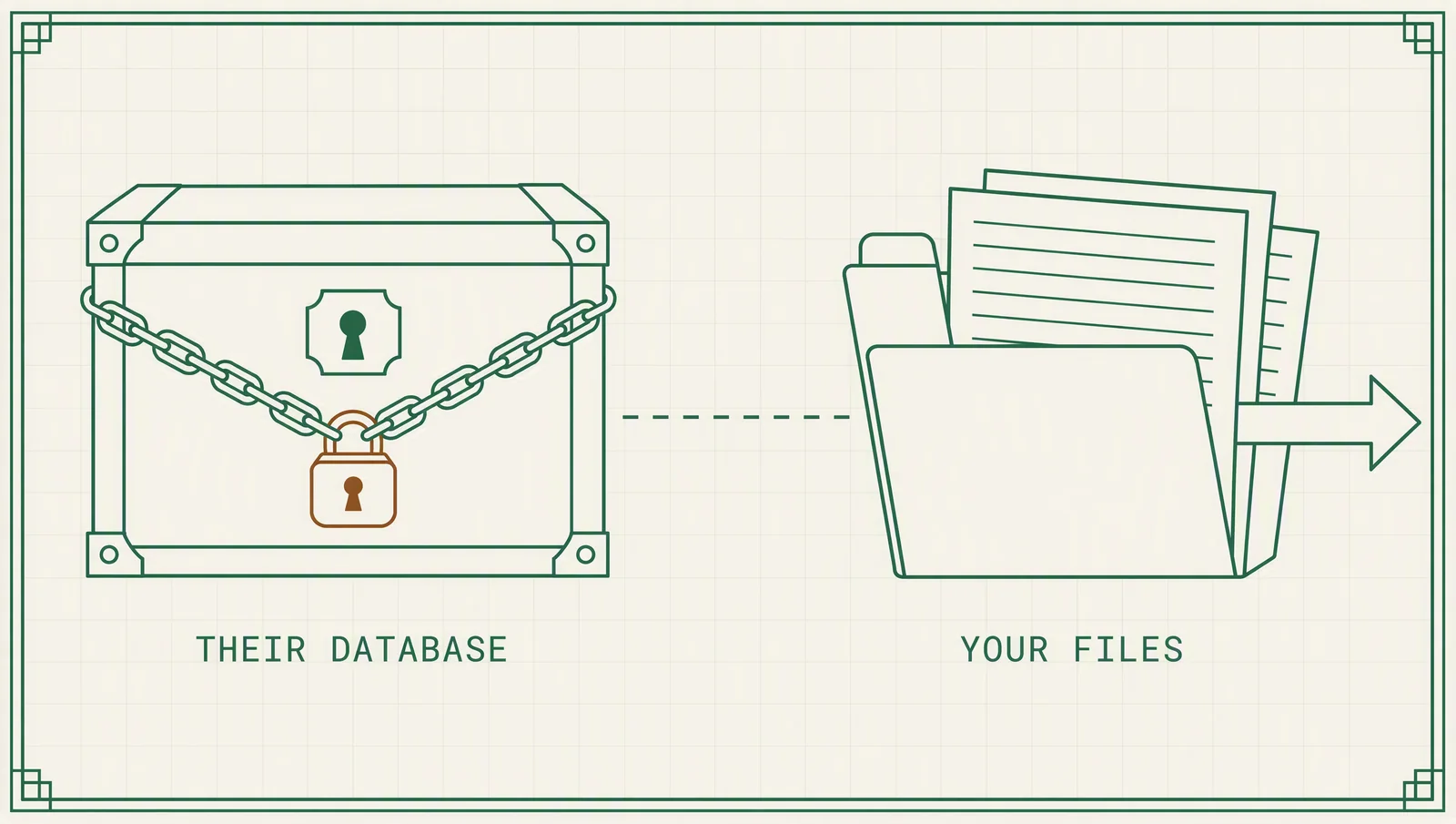
Every accounting tool has a page saying your data is yours. It is almost always true and almost always useless, because it means “you may request a copy in a format we chose, of the parts we decided to include, for as long as you keep an account with us.”
Ownership is not a promise. It is three properties, and you can test a tool for them in about five minutes.
The three tests
Can you read it without the vendor? Open the raw file. If what you see is a
proprietary export, a .qbo, or a ZIP of CSVs whose relationships only make
sense inside the app, you are holding a receipt for your data rather than the
data.
Can you keep working after you leave? A copy of last year is an archive. Ownership means the thing you took away is the same thing the tool was operating on, so another tool — or no tool — can carry on with it.
Does the history survive? Balances are the easy part. What almost never comes out is when each fact changed and why, which is the part an audit, a dispute or a nervous January actually needs.
Most tools pass the first test partially and fail the other two, and the reason is structural rather than malicious: if the books live in the vendor’s database, the database schema is the product.
Where the common options actually sit
| Tool | What your books are | Roughly | Leaving |
|---|---|---|---|
| QuickBooks | Rows in their database | ~$20–$128/mo depending on tier | Export files, no continuity |
| Digits | Rows in their database | from ~$100/mo | Export files |
| Puzzle | Rows in their database | $0–$300/mo | Export files |
| beancount.io | A Beancount ledger they host | $14.99/mo, or $8.33 annual | It is a text file |
| Beancount / hledger, self-run | A text file on your disk | Free | Nothing to leave |
| Countbean | A Beancount ledger in a git repo you can clone | Free, or $89 / $349 a year | It is a text file, in a repo |
The bottom three pass all three tests, and they pass it for the same reason: the books are plain text. Not exported as plain text — stored as plain text, in a format with a published grammar that several independent programs can read.
What plain text costs you, honestly
Self-run Beancount is free and it is genuinely the strongest answer to this question. It is also the reason plain-text accounting stayed a minority sport for twenty years: you write every posting yourself, in a text editor, and the tool has no opinion about which account a charge belongs to. That is forty small decisions a month typed by hand, and it is why people who love the idea still end up back in something with a web form.
Hosted plain text is the compromise: the storage format keeps the ownership properties, and something else does the typing.
- Your book is an ordinary git repository holding a Beancount ledger, and you can clone it. Shipped
- Every change — yours, the agent’s, the API’s — is a commit with a diff you can read. Shipped
- Every plan has every feature, including the free one; plans differ by how much you can do, not by what you are allowed to do. Shipped
That last point is the other half of lock-in. Feature gating is what makes leaving expensive even when the data is portable, because the thing you would lose is not the file, it is the multi-currency engine you built a year of books on top of.
The reason to stay on QuickBooks
Worth saying plainly, because a comparison page that concludes “we win” is not a comparison page.
QuickBooks has bank feeds. It connects to your bank, transactions appear without you doing anything, and for a business with a few hundred transactions a month that is not a convenience — it is the product. It also has payroll, tax filing, and an accountant three streets away who already knows it.
If those are what you are buying, buy those. The argument here is only for people who have looked at what happens to their books when the subscription lapses and did not like the answer.
The honest edge
The specific gaps in this specific alternative, stated where you can see them before you switch:
- There are no bank feeds and none are planned. Not built You export a file from your bank. That is also why every bank in every country works on your first day, with no integration list to be missing from — but it is a manual step every month.
- There is no one-click export yet. Not built The irony is not lost on us on this page of all pages: nothing is trapped, the repository is yours and clonable, but the button that hands you a bundle is not built. It is tracked as #48.
- The deterministic importer is being built. Building Today the model reads your CSV, which works and is not yet repeatable to the column.
- The receipt tool is being built. Building Photo-to-transaction works through the model; the dedicated tool with per-field confidence does not exist yet.
- No payroll, no tax filing, and the free plan will get limits. Not built It is a real book rather than a trial, but “free forever, unlimited” is not a promise being made here.